Showing posts with label 旅游/Travel. Show all posts

Tuesday, October 8, 2013

Korea Day 3: Bukchon Hanok Village, Changdeokgung Palace, Nanta

Third Day: March 28, 2013

Apart from being a center of latest trends and fashion, the city of Seoul also functions as a window to South Korea's past.  The government has spent numerous efforts in the maintenance of historical sites in an attempt to recreate its past, drawing the Koreans near their roots and constantly drawing admiration from foreigners.  We started our journey to the past at Bukchon Hanok Village.

Bukchon Hanok Village is a home to clusters of hanoks, the Korean word for Korean traditional houses.  One can opt to rent an audio guide for free, allowing one to choose among the given course routes or even to design ones own route while the machine gives directions and information about the place visited.  The place offers a variety of cultural activities for a small fee for those interested to be immersed in the local culture.  We did not participate in any of these, but just walked around the area to fully appreciate the beauty of the architecture of the hanoks and took some photos in five of the selected 8 views of Bukchon, the best views of Bukchon.


Bukchon 3rd View

Bukchon 4th View with countless hanok roofs in the background
Bukchon 5th View

Bukchon 6th View

Bukchon 1st View with Changdeokgung Palace behind

Located nearby is the Changdeokgung Palace.  It served as the secondary palace of the Joseon Dynasty and was declared a UNESCO world heritage in 1997.

Entrance to Changdeokgung Palace
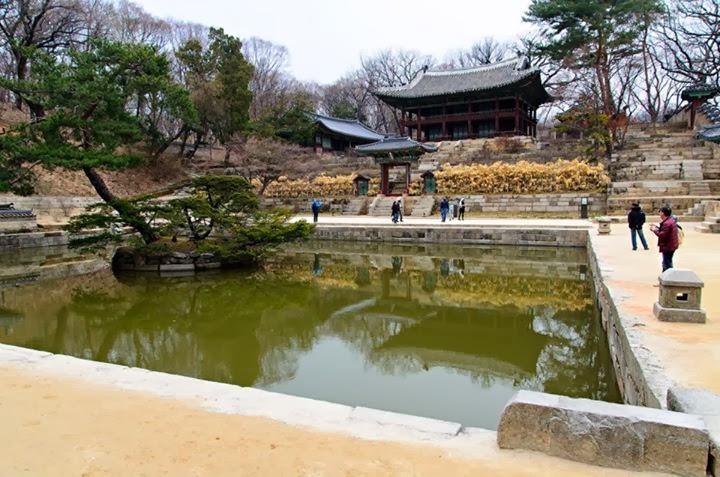
Built at the rear of the palace is the Secret Garden.  This is no ordinary garden.  It is so massive in size that one will get lost without the directions of a tour guide.  Several ponds and pavilions of various shapes can be found inside the garden.

One of the ponds found inside the garden
Thatch-roofed pavilion.  The king does farming himself to experience how it feels to work in the rice field.
Fan-shaped pavilion 
Because we had to catch the 8 pm Nanta show, we did not really have the chance to roam around Changdeokgung Palace.  We only took a quick look at Injeongjeon Area, the place where major state affairs were held, and left.

Injeongjeon
I recommend that one watch the non-verbal, comedy show Nanta even though the ticket price is quite expensive.  One will surely be amazed at how the tapping and hitting of different materials will come to create a harmonious sound.

Just before the start of the show


***************************************

Directions to Bukchon Hanok Village: Line 3, Anguk Station, Exit 2
Directions to Changdeokgung Palace: Line 3, Anguk Station, Exit 3


Tuesday, May 7, 2013

Korea Day 2: National Museum of Korea, Cheonggyecheon Stream, Myeongdong

Second Day: March 27, 2013

We visited the National Museum of Korea in the morning.  Because we had a walking tour scheduled at 2pm, we only gave ourselves an hour to roam around the museum.  Given the limitation in time, we decided to part ways and each headed to the section of one's interest.

Picture outside National Museum of Korea

Picture outside National Museum of Korea

Picture Outside National Museum of Korea

I went to the painting section.  I immediately noticed the similarity between Korean painting and Chinese painting, both in subject and in technique.

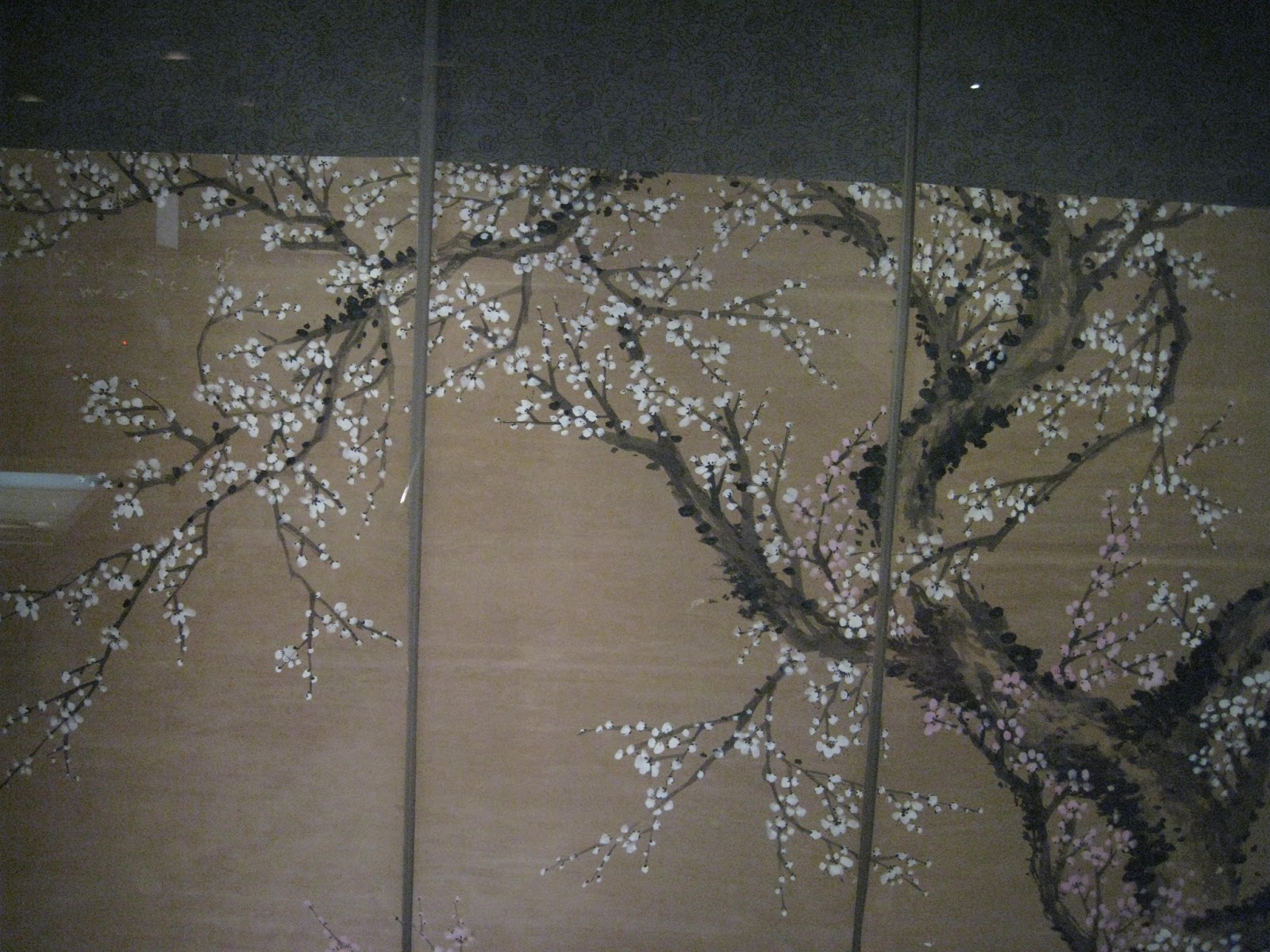
Paintings of the four gentlemen (bamboo, plum blossom, orchid, chrysanthemum), a very common subject in Chinese painting, can be found in the painting collection.

Plum Blossom Painting by Jo Huiryong

Bamboo Painting by Yi Jeong

A wooden plaque enumerating the different brush strokes used in landscape painting, exactly the same as those used in Chinese landscape painting, hung on one wall.
Different Brush Strokes in Joseon Landscape Painting.  Short-Linear Texture Strokes.
Different Brush Strokes in Joseon Landscape Painting.  Hemp-Fiber Texture Strokes.
Different Brush Strokes in Joseon Landscape Painting.  Ox-Tail Texture Strokes.
Different Brush Strokes in Joseon Landscape Painting.  Mi Dots.
Different Brush Strokes in Joseon Landscape Painting.    Vertical Texture Strokes.
Different Brush Strokes in Joseon Landscape Painting.  Ax-Cut Texture Strokes.

Makes me wonder how the two cultures came to develop the same art form and in what ways one differs from the other, if there are any.

We grabbed some gimbap at 711 on our way to Cheonggyecheon Stream; there was no time for lunch.  Still, we arrived late at 230pm and our tour guide was nowhere to be seen.  We had no idea whether he left out of impatience or he had not come at all as suggested by the unanswered phone after numerous calls by my brother; thus, we walked along the stretch of Cheonggyecheon Stream on our own.

Starting point of Cheonggyecheon Stream
History of Cheonggyecheon Stream*:
>  The stream used to be a site where women would do their laundry.
>  In 1958, the water became so polluted that it was covered with concrete.
>  In 1971, an elevated highway was constructed over the stream bed.
>  In 2003, the Cheonggyecheon Restoration Project was started, which would remove the elevated highway and restore the stream.
>  In 2005, the Cheonggyecheon Restoration Project was completed.  The stream was restored to its form today.

*For more information, visit cheonggyecheon.or.kr 

Cheonggyecheon Stream is the place to go for relaxation.  One can just walk along the path as long as one wants, and stop at any point whenever one wishes to.

Various art works can be found along the stream.  Shown here is the  Banchado of King Jeongjo's Royal Parade.  This is a mural painting of King Jeongjo visiting his father's tomb on his mother's 60th birthday in 1795.
We stopped at Jangtonggyo Bridge, the 3rd of the 22 bridges over the stream, and proceeded to Myeongdong for shopping.

Myeongdong Catholic Cathedral

************************************************

Directions to National Museum of Korea: Line 4, Ichon Station, Exit 2

Directions to Cheonggyecheon Stream: Line 5, Gwanghwamun Station, Exit 5

Thursday, April 18, 2013

Korea Day 1: Gangnam Area

First Day: March 26, 2013

We arrived at Incheon International Airport at 6am.  Just in time for the 10am walking tour I had reserved days before our trip, or so I thought.  We waited for about an hour in the immigration, partly due to a number of tourists who cut in line.  Then, we rode the wrong train to our hostel.  Instead of taking the ordinary train (one that stops on every station), we took the express train that leads directly to Seoul Station, and had to backtrack two stations to Hongik Station.  We had no idea of which subway exit to go as my brother forgot to take note of the one nearest to our hostel.  A couple of minutes was spent on asking directions, a few more on checking-in, and more on travelling to our destination.  When we finally reached Seolleung, it was way past our scheduled time; it was already 11am.  Fortunately, our tour guide had patiently waited for us.

Seolleung houses the tombs of the 9th king of the Joseon Dynasty and his second wife.  According to our tour guide, during the Joseon Dynasty, the royal family practiced Confucianism and denounced Buddhism.  Because Confucians do not believe in afterlife, there were no funerary objects of any sort buried with the dead as practiced in royal burial ceremonies in other cultures.  This is why when the Japanese came digging for treasures, they found nothing but the remains of the dead.

The burial mounds are located in the high points of the area to signify the high social status associated to the king and his family.  Surrounding them are stone statues of animals, facing outward, ready to protect the king against any impending danger.  Arranged to reflect the order of ranking, the stone status of two civil officials are placed one step lower the burial mound, but one step higher the stone status of two military officials.

Aside from being a historic site, Seolleung is also a home for a forest of pine trees.  I believe this is the reason why the place is frequented by sketchers; we saw amateur artists, each preoccupied with their own work of art, on our way out.

Located five minutes by car is a Buddhist temple, Bongeunsa Temple.  Our tour guide helped us find a temple guide better equipped to tour us around than she is.  We were introduced to two series of paintings mounted on the four walls of one temple.  The first series depicts the life of Buddha from his birth to his enlightenment, while the second series, placed right below the first one, makes use of the story of how a boy was able to tame a cow to symbolize the life of Buddha.  Each painting in the second series corresponds to a painting in the first series.  The walking tour ended in the 23-meter tall Maitreya Buddha Statue, which was constructed for hope of peace between South and North Korea.

Entrance of Bongeunsa Temple

Buddha Statue inside Bongeunsa Temple


Our tour guide then left us pondering on the irony of a Buddhist temple placed side by side with the resting place of an anti-Buddhism royal family.  I highly recommend the Seoul City Walking Tour to anyone who wishes to gain a deeper understanding of some of Seoul's frequently visited spots.

We had lunch in COEX Mall, located just across Bongeunsa Temple.

COEX Mall
We left for Apgujeong-dong after.  Apgujeong-dong is a shopping street renowned for high-end stores.

The building behind is Galleria Department Store in Apgujeong Street.  It houses luxury brand stores.

We were so tired that we decided not to proceed to Garosugil, the Gingko tree-lined street.

And there ends our tour of Gangnam, the area which inspired the song, Gangnam Style.

*******************************************************************************

For the selection of walking tour routes and to join one, visit http://www.visitseoul.net/en/statics.do?_method=includeHtml&category=/&fname=tour_walk&m=0004004004001&p=04

Directions to Seolleung: Line 2, Seolleung Station, Exit 8


Sunday, April 29, 2012

Three Gorges, China Trip

I started out the trip to Three Gorges to witness the beautiful scenery I am looking at now - mountains after mountains along the long stretch of Yangtze River, each having its own unique form, some depicting images of animals (elephant, snake), others of holy beings (buddha, goddess).

But what attracted me most is the history of the place. Inundation, caused by the river, had long been a major threat to the locals. In response to this, the government started the construction of the Three Gorges Dam in 1994. Together with the benefits brought by the project, including flood prevention, electricity generation, rise in tourism, come other undesirable outcomes. The river's water level rose so high that many villages located along the river bank were buried underwater - forever. The locals were forced to move out from their simple lifestyle, and all will never be the same again.

History is what distinguishes one place from another. I believe that it is the story of Yangtze River that would remain in me every time I think of Three Gorges.

Shibaozhai Pagoda (Upper left) is an old multi-storey wooden architectural structure built without the use of nails. Mountains of the shapes of scissors (Upper center), elephant (Lower left), buddha (Lower center), snake (Lower right) can be found while passing through the area.


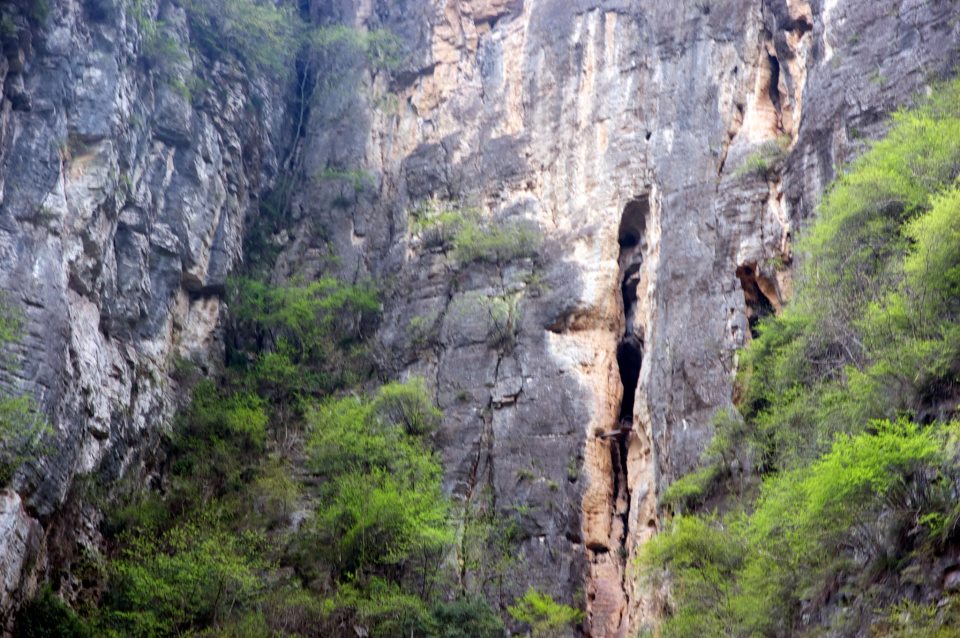
Hanging coffins placed on cliffs were found in the Three Gorges region. Many speculations were made as to why the coffins were put as such. Some believe that the high levels represent the people's respect to their ancestors, while others say that this kind of burial ceremony protects their ancestors' body from animal attacks. It is still unknown today as to how such heavy coffins were placed atop.

On the Three Gorges Dam. I find the 5-stages ship lock very interesting. It raises or lowers the ship when travelling upstream from Yichang to Chongqing or downstream from Chongqing to Yichang. The ship enters the first stage, and when the gate behind it closes, the water level rises/lowers. Once the water level is the same as that of the next stage, then the gate in front of it opens for the ship to proceed to the next stage. The gate closes again, and the same process is repeated four times. The whole process may sound simple, but it takes approximately 5 hours to complete the whole process.

Thursday, April 1, 2010

跟大学同学的毕业旅行: 香港4

第四站:Avenue of Stars

在美丽的夜晚,向着大海,看着香港众楼的灯光表演。

Wednesday, March 31, 2010

跟大学同学的毕业旅行: 香港3

第三站:大佛

人家说血拼是女人的爱好。女同学们看见这里的商店都迫不及待地想买东西。我则是个例外。从不喜欢逛街的我正懊恼着这三个小时要做何事,正好看见一位男同学正在看大佛的地图。就这样我跟两位男同学一起搭巴士上山观赏大佛。经过查询以后才得知这尊大佛是全世界最大的铜佛。


回去途中会经过NgongPing Village;是一个卖纪念品的场所。每一家商店都有着古屋的形状,让人有一种回到中国古代的感觉。


沿途上还可看见多辆假游览车,每一辆都代表着不同国家的国旗。


这里也提供许愿亭。愿我的家人都身体健康,平平安安,心想事成。愿我找到自己喜爱的工作,找到我人生的方向。你呢?


最后再搭三十分钟的游览车旅程下山,从不一样的角度观赏香港的自然美景。


*This picture was taken by my classmate.

跟大学同学的毕业旅行: 香港2

第二站:澳门

期待已久,终于有机会去澳门,但...

我生病了!难道又要错过机会?

去年我参加了JTA,在台湾待了一个学期。在这期间,我的家人到澳门,看看我姐的工作环境。

没想到我这次又要错过了。只好再等下一次机会了。

Tuesday, March 23, 2010

跟大学同学的毕业旅行: 香港1

第一站: 海洋公园


第一次到这儿已经是很多年前的事了; 那时是我第一次出国第一次去香港。只记得妹妹因为恐龙的吼声哭得特别厉害。现在, 除了一棵有着恐龙形状的树, 已看不到恐龙的任何痕迹。大概是吓着了很多孩子吧,哈哈。


放慢脚步,欣赏周边的一草一木。这里可能是再普通不过的观光景点但也可能是一个美好的景色,一切只在于个人的看法: 你愿不愿意打开双眼认真欣赏眼前的美?慵懒的熊猫。各种各样的水生。虽然全都是鱼类但仔细一看每一种都有牠的特色,如同我们一样虽然都是人类但因独特的长相,个性,以及相处方式造就了不一样,独一无二的自己。


上了游览车从不一样的角度欣赏游乐园。


再来点刺激的吧!真的不行,就来假的吧。


最后观赏海豚表演。第一次来错过了,这次绝不能再错过。